Feeling disconnected from the body: an experience that suspends consciousness between two worlds

Written by: Ahmed Shashi
Have you ever looked at your body as if it were foreign to you? Have you ever felt like you were watching yourself from afar, unable to control what was happening? That moment when the "ego" separates from the body is not just imagination; it is one of the most mysterious and astonishing human experiences. Some describe it as a temporary journey outside the body, while others experience it as a realistic nightmare that leaves them confused for years.
Scientists call it an out-of-body experience or OBE, and those who have experienced it describe it as being closer to the boundary between life and death, consciousness and sleep, reality and illusion.
The moment of separation: when the body becomes visible
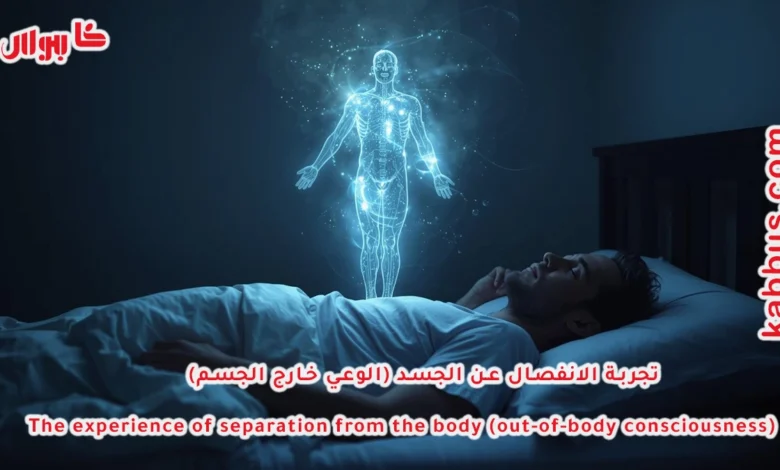
The experience often begins with a strange feeling, as if something is slowly being pulled out of you, your spirit retreating a step back, watching without control. People who have had the experience talk about a slight feeling of lightness in the body, followed by a slight spinning of the head, and then suddenly... you find yourself looking down at your sleeping body below you.
Sarah, a 30-year-old doctor, describes her experience:
“I had a fever that night. My temperature rose suddenly, and then I felt like I had left my body. I saw myself sleeping, my face very pale. Strangely, I did not feel afraid, only fascination and calm, as if my body no longer belonged to me.”
Others say they feel pain for a few moments, then everything disappears. It is as if the boundaries of the senses are disrupted and perception becomes free, unencumbered by sensory limitations. Some see themselves floating above the bed, while others see their faces and reflections on the ceiling or in mirrors.
In rare cases, the person goes beyond self-monitoring to broader scenes, reporting that they saw streets or houses they had never been to before, which later turn out to be real places. This is where the most puzzling questions begin: did consciousness really leave the body? Or is the mind creating an amazing illusion to explain severe internal turmoil?
A story between consciousness and death
An American astronaut wrote in his diary that during a mission outside the station, he suddenly felt as if he were floating inside and outside his body at the same time, hearing the distant voices of his colleagues without being able to control his response. For a moment, he thought he had died, but then he returned to the artificial respiration systems.
In cases of heart attacks, some patients who survived clinical death recount seeing their bodies on the operating table, hearing the doctors talk but unable to speak. One of them said:
“I could see everything from above. I saw them trying to revive me, and when I screamed, no one heard me. Then everything went black again.”
These experiences are not specific to any particular culture or religion; similar cases have been recorded in both the East and the West, among believers and atheists, young and old, suggesting that the phenomenon is not a limited spiritual myth, but rather a profound human condition that has recurred in different ways throughout history.
The scientific aspect of the experiment
From a neurological perspective, scientists explain the phenomenon as temporary disturbances in the right parietal lobe of the brain, which is responsible for sensing the spatial boundaries of the body.
Professor Olaf Blanke of the University of Geneva, one of the leading researchers on the phenomenon, says that when this lobe is subjected to electrical interference or a malfunction in the sensory signals between sight and touch, the brain creates the illusion that the person is somewhere other than their own body.
In other words, what the individual sees is not a real exit, but a "perceptual reconstruction" of the location of the self.
However, even with this explanation, significant questions remain. How can a mind clouded by stress or lack of oxygen generate images that sometimes correspond to what actually exists outside the field of vision? And how do survivors of death recall precise information that occurred during their clinical absence? Some believe that the conscious mind has undiscovered capabilities that transcend the physical concept of existence. Between neurological explanation and spiritual vision, a gap remains, unbridged by logic or experience.
The body as a constraint, consciousness as a horizon
At the moment of separation, most of those who have undergone the experience describe a vague sense of peace, as if they have been freed from the weight of the body. One of them says:
“I saw the world more clearly, colours were deeper, there was no pain, no fear. I was breathing light.” Others described the experience as more terrifying, especially when they felt unable to return, as if an unknown force was pulling them away. Some screamed but no sound came out, and others felt that time had completely disappeared, as if a minute had turned into an eternity.
Psychologically, the condition may represent a natural reaction to severe stress or emotional trauma. When the brain is unable to process pain, it temporarily disconnects consciousness from physical sensation to protect us from breaking down. It is purely a defence mechanism, but sometimes it takes on an extraordinary form.
Between medicine and spirit
Scientific explanations remain confined to the realm of the brain and neuroelectricity. However, ancient spiritual traditions—in Buddhism, Hinduism, Sufi Islam, and others—speak of "spiritual journeys" and "astral projection," and of the soul's ability to temporarily leave the body during sleep, meditation, or coma.
Some monks say that they reach a stage where they observe their bodies as if from a high place, and consider this a sign of the sublimity of the soul when it is freed from material desires.
In contrast, psychologists believe that this description is nothing more than a complex brain activity that generates a feeling of detachment.
Between these two views, the answer may lie somewhere in the middle: perhaps it is not a matter of something physical leaving the body, but rather of expanding one's perception to include a new image of oneself, transcending one's skin and bones to encompass the space around them.
Those who have lived through the experience... never return as they were before.
After returning to the "inside," many people say they have changed radically. Fear of death is no longer what it used to be, and material things no longer have the same value. Some have become more religious, while others have decided to completely change the course of their lives. Laila, a teacher who went through this experience after a horrific car accident, describes it as follows:
“I was hanging in the air, seeing the overturned car and looking at my body between the metal bars. I wondered how I could be there and here at the same time. When I woke up in the hospital, I cried for a long time, but I was no longer afraid of death.”
Some become hypersensitive to everything related to time and place, while others become calmer, as if they have touched something from the other side. The experience can sometimes be painful, but it always leaves an indelible mark.
Where does awareness begin? And where does it end?
If the experience of separation from the body is merely an illusion of the brain, where does that real feeling of witnessing come from?
And if it is an actual departure of the soul, how can the mind record and store the event?
The boundaries between the two interpretations remain unclear. Perhaps the question is not "What happened?" but "Who are we really?"
Are we the body that can be seen and touched, or the consciousness that sees it?
Is the body the home of the soul or its prison?
At some point, when everything stops, only pure awareness remains. The experience of separation from the body seems to reveal a fleeting glimpse of this great awareness, that moment when a person realises that their existence is deeper than flesh and bone, and broader than their spatial limitations.
The mysterious consciousness
Ultimately, the full truth of the out-of-body experience cannot be ascertained. Science explains it as a neurological malfunction, philosophy sees it as a moment of spiritual enlightenment, but the human experience itself says much more than that.
Perhaps in it, a person experiences something like a "glimpse of death" or simply a dream whose boundaries have been broken. But it undoubtedly changes our view of life and makes us wonder:
If we could see our bodies from the outside, would we really be living inside them? Or is it the body itself that lives inside us, like a fleeting image in a consciousness broader than all the senses?
Between science and the unknown, the feeling of separation from the body remains a mystery that reminds us that we are not merely biological beings, but rather consciousness searching for its true home, in a world that can only be perceived when we leave it... even if only for a moment..




 English
  Arabic